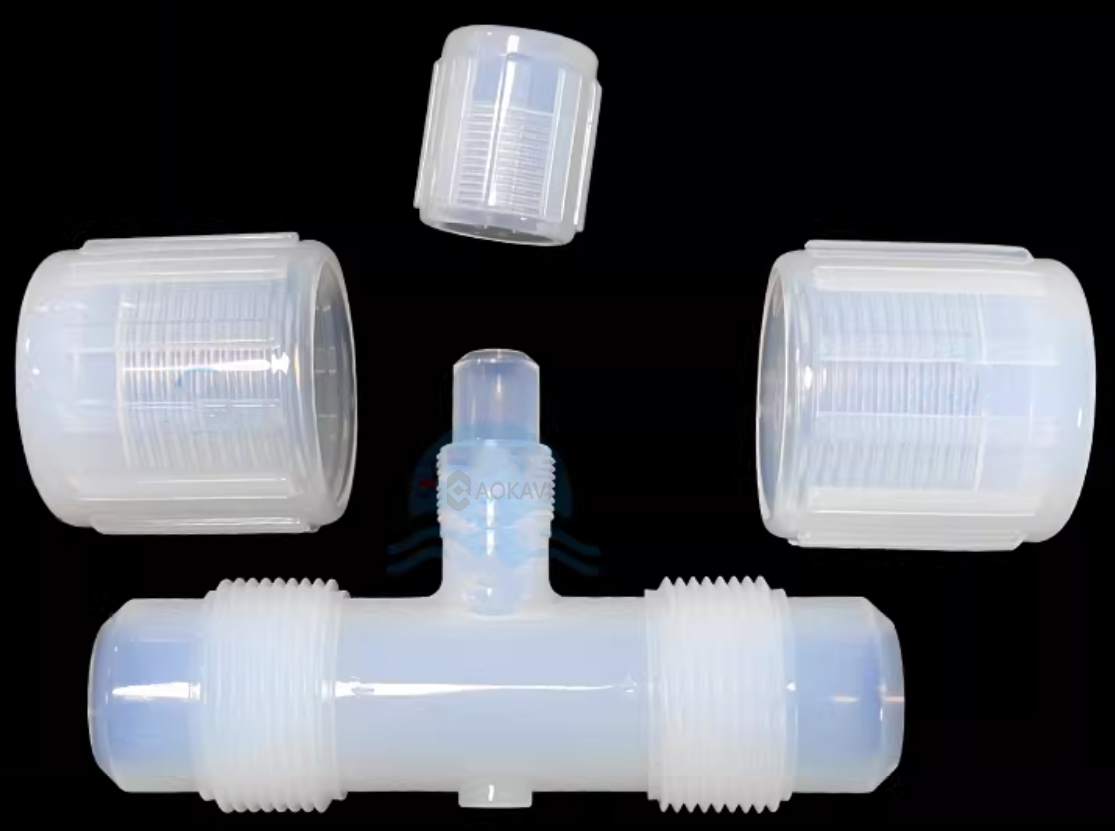
I. Product Definition & Core Function
The PFA Reducing Union Tee is a piping fitting with at least two different sizes among its three ports, arranged in a "T" or "cross" configuration. It is not merely a simple flow-splitting or combining element but an intelligent hub that enables connection and flow redistribution between piping systems of different diameters. All wetted surfaces are made of high-purity PFA, meeting the requirements for high-purity and corrosive media while solving key challenges of pipe size matching and flow control in complex systems.
Its core value lies in system integration and adaptation. At a single node, it can simultaneously accomplish the dual tasks of "size transition" and "flow distribution", making it an ideal bridge for connecting main lines to smaller branch equipment (or vice versa). This greatly simplifies system design and optimizes flow distribution.
II. Core Design Value
Dual-Function Integration: Achieves both pipe size conversion and fluid distribution within a single component, eliminating the need for extra reducers and saving space. This reduces potential leak points and enhances overall system integrity and reliability.
Optimized Flow & Pressure Management: Through carefully designed reducing flow paths, it can intentionally adjust the flow ratio between branch and main lines or reduce turbulence and pressure loss during flow combining, enabling more controlled processes.
All-Fluoropolymer Flow Path, Absolute Safety: The entire flow channel is integrally molded from high-purity PFA, ensuring fluid contact only with inert PFA material throughout its journey. This completely isolates the risk of metal contamination, meeting the highest cleanliness requirements for semiconductors, biopharmaceuticals, etc.
Enhanced Design Flexibility: Provides engineers with a powerful tool to elegantly address design challenges such as mismatched equipment port sizes and the coexistence of branches with different flow requirements, resulting in more compact and efficient system layouts.
III. Interface Details
The three ports of a PFA Reducing Union Tee typically use the same connection method (Flared or Beaded type) to ensure installation consistency. The key lies in the combination of port sizes.
Size Combination Patterns:
Main Line with Reduced Branch: The most common type. The two ends of the main run are the same size, while the branch port is smaller. Example: 1/2” x 1/2” x 1/4”, indicating a 1/2-inch main run and a 1/4-inch branch.
Reduced Combining Type: Two inlets of different sizes combine into one larger or smaller outlet. Suitable for specific mixing or collection processes.
Connection Methods: Consistent with the entire PFA fitting series, two mature and reliable options are provided:
Flared Type: For permanent, high-pressure rigid connections, ensuring long-term stability at distribution nodes.
Beaded / Ball & Socket Type: For flexible connections requiring quick connect/disconnect for easy maintenance and cleaning, especially suitable for modular systems and bioprocessing.
IV. Standard Size Range & Selection Reference
PFA Reducing Union Tees are commonly used for integration in precision fluid systems. Their size combinations typically start from 1/4 inch up to a maximum of 1 inch. The key to selection is clarifying the size relationship between the main run and the branch.
Key Selection & Installation Points:
Define Flow Direction & Size Roles: During design, it is essential to clarify which are the main inlet, main outlet, and branch direction, and confirm the corresponding sizes. They must not be reversed during installation.
Consider Branch Flow: The reduced branch will significantly affect its flow rate and pressure. Calculations are needed to ensure it meets downstream equipment requirements.
Space Planning: The shape of a reducing tee may differ slightly from an equal-diameter tee. Confirm its spatial footprint before installation to avoid interference.
System Balance: In systems with multiple parallel reducing branches, consider the impact of different branch resistances on flow distribution. Fine-tuning with valves may be necessary.
V. Core Application Fields
The PFA Reducing Union Tee is key to achieving integrated system design and precise flow control, widely used in:
Semiconductor Manufacturing: In ultra-pure chemical distribution systems, tapping smaller diameter branches from larger main distribution lines to supply individual process chambers or cleaning stations with varying chemical consumption rates.
Biopharmaceuticals: In fluid preparation and distribution systems, branching different-sized lines from large-diameter media/buffer tank outlet pipes to connect to bioreactors or filtration systems of varying scales.
Chemical Processing: Controlled distribution of reactants from high-flow lines to multiple parallel small-scale test or pilot reactors via reducing tees.
Integrated Laboratory Systems: Building complex fluid handling platforms to achieve adaptive connections from main solvent delivery lines to sample inlets of different specifications for chromatographs or reactors.
Summary
The PFA Reducing Union Tee, with its combined function of "size transition and flow distribution", serves as the essential "System Adapter and Flow Manager" in high-purity and corrosive fluid systems for achieving system integration and flow optimization. It transcends simple pipe connection, elevating to the level of system architecture to provide an efficient and clean solution for interconnecting multi-scale equipment and achieving precise process control. Whether building permanent industrial facilities based on Flared Type connections or deploying flexible bioprocessing production lines based on Beaded Type connections, correctly selecting reducing tees is a crucial step towards achieving efficient, reliable, and cost-effective system operation.