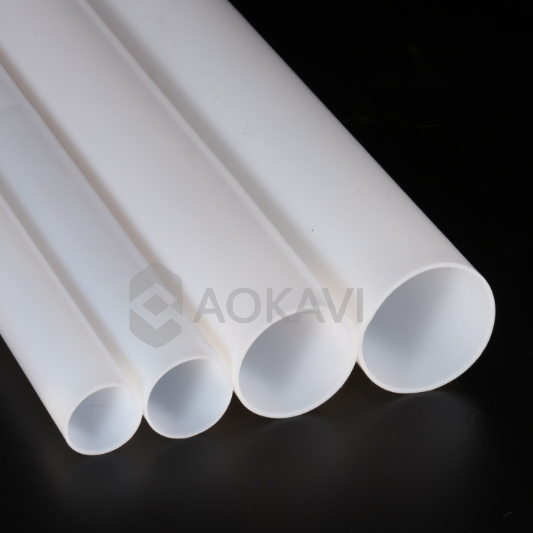
In the world of industrial materials, there exists an unassuming yet ubiquitous "Plastic King" – polytetrafluoroethylene (PTFE) tubing. With its milky white or translucent appearance, this seemingly ordinary tubing hides astonishing superpowers. From chemical plants immersed in concentrated acids to human blood vessels, from deep-sea desalination units to spacecraft hydraulic systems, PTFE tubing silently safeguards the lifelines of modern industry with its ultimate chemical inertness, broad temperature tolerance, and mirror-smooth inner walls in demanding environments.
I. Core Properties of PTFE Tubing: The "All-Round Performer" of Engineering Materials
Fortress Against Chemical Attack
PTFE tubing's molecular structure consists of tightly bonded carbon-fluorine bonds (bond energy up to 466 kJ/mol), acting like seamless armor. It withstands over 3,000 chemical media, including aqua regia and hydrofluoric acid, demonstrating absolute inertness to more than 98% of chemicals. In extreme pH environments (pH<2 or pH>12), where metal tubing might corrode and perforate within hours, PTFE tubing remains functional for over a decade.
Temperature Guardian Across Extremes
PTFE maintains consistent performance from cryogenic liquid nitrogen temperatures (-80°C) to high-temperature steam (260°C). It can even withstand short-term thermal shocks up to 300°C. While rubber seals thermally degrade at 150°C, PTFE tubing reliably seals aircraft hydraulic systems (under 3000 psi pressure).
Nature's "Non-Stick" Fluid Pathway
With a surface friction coefficient of just 0.04 (equivalent to 1/5th of ice friction), its dynamic and static friction coefficients are identical. This reduces fluid resistance by over 40%, significantly lowering pumping energy consumption. Its surface energy is only 18-24 mN/m, with adhesion residue from substances like algae or chocolate below 0.02g/m² – easily cleaned with low-pressure water flow.
The Invisible Guardian: Safety and Durability
Certified as FDA food-grade and medically biocompatible, it's used in artificial blood vessels (clinical use exceeding 10 years) and pharmaceutical delivery. Its wear resistance is 5 times higher than nylon, and it lasts over 3 times longer than rubber tubes in abrasive slurry transport.
II. Addressing PTFE's Challenges: Limitations and Smart Solutions
PTFE is not without limitations:
Mechanical Strength Gap: Pure PTFE tensile strength is only 21-28 MPa, less than 1/10th of metal tubing.
Pronounced Thermal Expansion: High thermal expansion coefficient may affect sealing during rapid temperature changes.
Installation Expertise Required: Low friction causes traditional threaded connections to loosen easily, requiring specialized compression techniques.
Materials Science Breakthroughs:
III. Ubiquitous Applications: Where the "Plastic King" Permeates Modern Industry
Chemical Industry's "Bulletproof Vest"
The preferred tubing for strong acid environments – hydrofluoric acid lines, chlorine reactor liners. One chemical plant reduced leaks by 90% and extended maintenance intervals from 3 months to 2 years after switching to PTFE-lined piping.
Guardian of Life and Health
Key medical applications:
IV catheters: Biocompatibility prevents allergic reactions.
Artificial blood vessels: Vascular replacements in bypass surgeries.
Sterilization systems: Withstands repeated 135°C steam sterilization.
Water Treatment's Green Pathway
Smooth walls prevent algae growth in desalination pretreatment; PTFE heat-shrink seals for RO membranes reduce leakage below 0.01%; withstands chlorine-based disinfectants, lasting 5 times longer than PVC pipes.
Unsung Hero of Advanced Manufacturing
Semiconductors: Ultra-pure water lines ensure chip yield.
Automotive: PTFE transmission guides reduce friction to 1/8th of bronze bushings.
Food: Chocolate transport lines show 5x less residue than stainless steel.
Energy: Nuclear plant boric acid lines endure radiation doses up to 10⁶ Gy.
"Lubrication Master" for Moving Parts
Maintenance-free PTFE bearings in paper machinery; PTFE-coated injection molding guides extend service life from 500 to 2000 hours.
IV. Future Outlook: Evolution from Earth to Deep Space
As technology advances, PTFE tubing is evolving toward functionalization and intelligence:
Nano-enhanced: Graphene-modified PTFE tubes (under testing) show 5x thermal conductivity.
Sensor-integrated: Smart tubes with embedded fibers monitor corrosion/leaks in real-time.
Space-grade: All-PTFE hydraulic lines in Mars rovers withstand -130°C cold and abrasive dust.
Installation Tips:
Maintain bend radius ≥5x tube diameter to prevent stress cracks.
Use mating metal surfaces with roughness Ra≤0.8μm to minimize wear.
Replace if wear exceeds 10% of initial thickness.
From laboratory test tubes to spacecraft, PTFE tubing bridges fluid systems with its chemically inert body and powers machinery with its low-friction spirit. It embodies the essence of materials science: True strength lies not in rigidity, but in retaining its essential nature under extremes, silently upholding the progress of human civilization.