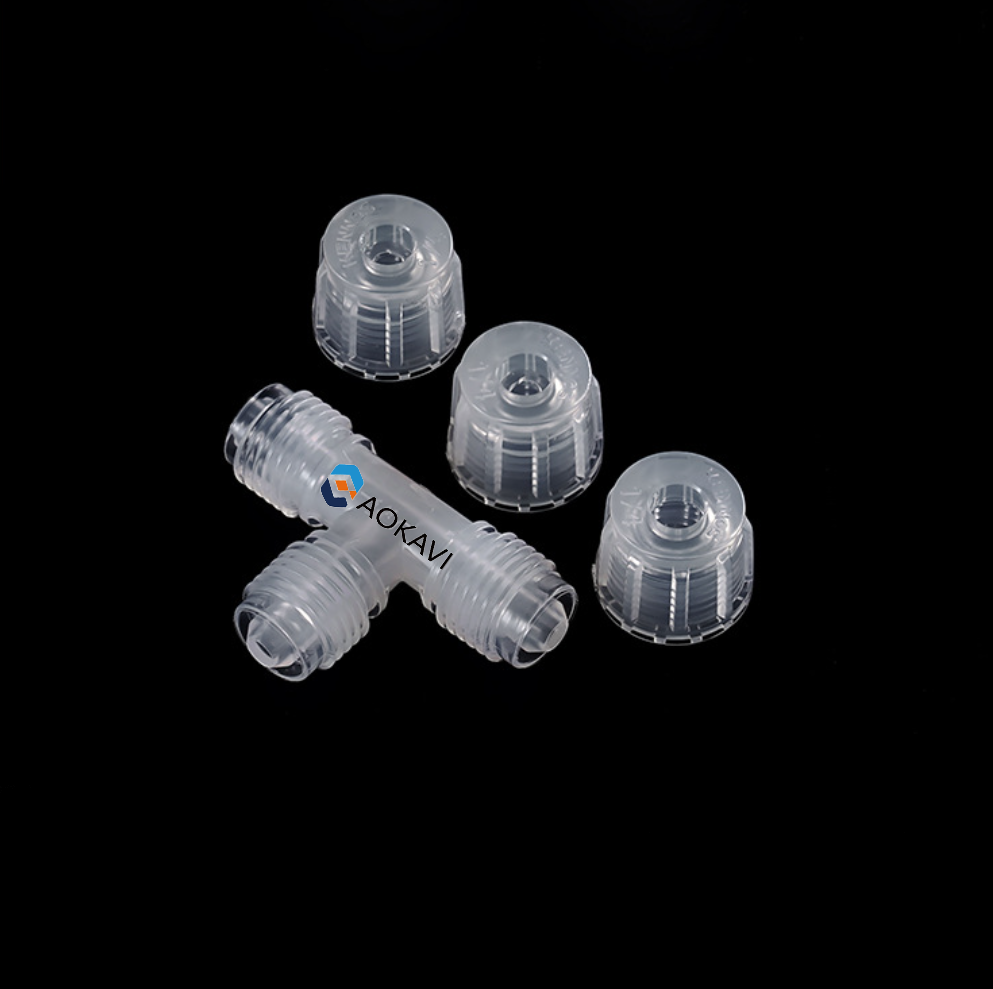
When we talk about semiconductors, we usually think of nanoscale chips, precision lithography machines, and dust‑free wafer fabs. Few people notice that behind all this cutting‑edge equipment, a humble plastic pipe fitting—the PFA equal tee—quietly carries the vital task of transporting the “lifeblood” of semiconductor production.
Why Does Semiconductor Manufacturing Require “Ultra‑Pure” Piping?
Manufacturing a single chip involves hundreds of process steps—from wafer cleaning, photolithography, and etching to chemical mechanical polishing. Almost every step demands ultrapure water and a variety of high‑purity chemicals, including highly corrosive hydrofluoric acid, concentrated nitric acid, photoresists, developers, and more.
The purity of these fluids directly determines chip yield and performance. Even trace amounts of metal ions or organic impurities leached from the piping system can cause short circuits or degrade device characteristics. That is why the semiconductor industry imposes extremely stringent requirements on piping systems: materials must be highly corrosion‑resistant, release almost no contaminants, withstand elevated temperatures, and maintain adequate mechanical strength.
PFA: The “All‑Rounder” Born for Semiconductors
So which material meets such demanding criteria? The answer is PFA—perfluoroalkoxy resin.
PFA belongs to the fluoropolymer family and is a close relative of the well‑known “Teflon” (PTFE). However, PFA has a key advantage: it can be processed by conventional melt‑processing techniques, like ordinary thermoplastics, which makes it possible to manufacture complex fittings and shapes.
Moreover, PFA offers a nearly “perfect” set of properties:
Exceptional chemical resistance: PFA withstands almost all strong acids, bases, and organic solvents, including aqua regia and hydrofluoric acid. Whether conveying concentrated sulfuric acid or hydrogen peroxide, PFA piping performs reliably.
Wide operating temperature range: PFA remains stable from –200°C up to +260°C over extended periods. Many semiconductor processes involve elevated temperatures, and PFA handles them with ease.
Ultra‑low extractables: PFA is inherently “clean,” releasing virtually no metal ions or organic compounds into the fluids it carries—critical for maintaining the purity of ultra‑high‑purity chemicals.
Excellent non‑stick surface: The inner wall of PFA tubing is extremely smooth, preventing chemical residues from adhering and reducing the buildup of contaminants, which also simplifies cleaning.
Thanks to these characteristics, PFA is widely recognized as the material of choice for fluid handling in semiconductor manufacturing.
Equal Tee: The “Traffic Hub” of the Piping System
Good tubing alone is not enough—it must be connected with reliable fittings. In the complex fluid networks of semiconductor equipment, fluids constantly need to be split, merged, or redirected. This is where the equal tee comes into play.
“Equal” means that all three ports of the tee (one inlet and two outlets, or vice versa) have the same diameter. The equal tee functions like a Y‑shaped junction: it evenly divides one fluid stream into two, or combines two streams into one.
In wet processing tools for semiconductor manufacturing—such as wet etchers, wafer cleaners, and chemical vapor deposition systems—equal tees are ubiquitous, distributing and delivering process chemicals to where they are needed.
Why Does “Equal” Matter?
You might wonder: Isn’t a tee just a tee? Why does it matter whether the diameters are equal or not?
In semiconductor fabrication, stable fluid velocity and pressure are essential. If the pipe diameter suddenly changes, the flow velocity can shift abruptly, causing turbulence, bubble formation, or even particle entrapment at the diameter transition. The equal‑diameter design ensures that fluid passing through the tee maintains stable velocity and pressure, minimising flow disturbances and the associated risks, while also extending the service life of the entire piping system.
Reliable Connections: Butt Welding and Flare Joints
PFA equal tees can be connected to tubing using two primary methods:
Butt welding involves heating the PFA material to melt it, then fusing the tee and the tubing together to form a strong, homogeneous joint. This method offers excellent sealing performance, withstands high pressures, and eliminates additional sealing components, thereby reducing potential leak points and contamination sources.
Flare connections use heat to expand the tube end into a conical shape, which precisely mates with the corresponding conical surface of the fitting body, secured by a nut. This approach is easy to assemble and disassemble, making it suitable for applications that require periodic maintenance.
Industry Standards: Setting the “Red Line” for Quality
Given the critical role of PFA fittings in semiconductor manufacturing, the industry enforces strict quality specifications. Internationally, SEMI F57 is a widely recognised standard for high‑purity polymer materials used in semiconductor applications. In China, a corresponding group standard for Semiconductor‑Grade PFA Tubing has also been established, setting extremely rigorous limits on total organic carbon, metal ion extractables, and other key parameters.
Summary
The birth of every chip relies on the flawless coordination of countless precision processes. Although the PFA equal tee is just a small pipe fitting, its outstanding corrosion resistance, exceptional purity, and reliable connections ensure that ultrapure chemicals and water are delivered safely and consistently to every process step.
In the grand narrative of chip manufacturing, this unassuming “piping hub” stands as an unsung hero, quietly safeguarding the purity and yield of every single chip.