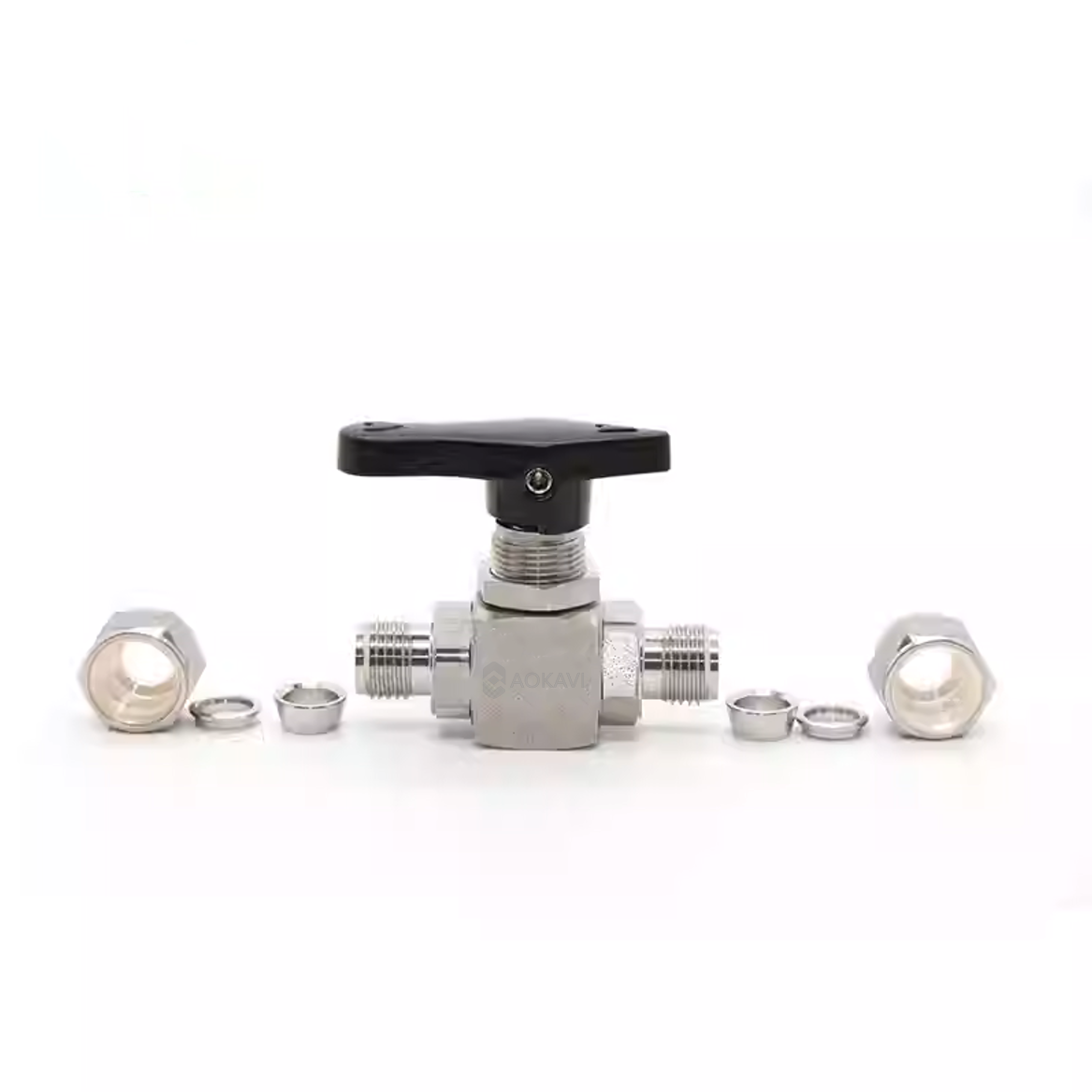
Product Overview
AOKAVI special alloy ball valves utilize aerospace-grade special metal materials, specifically designed for harsh service conditions involving high temperature, high pressure, and strong corrosion, ensuring zero-leakage reliable control in various extreme environments.
Product Structure & Advantages
(I) Core Structure Breakdown
Valve Body: Manufactured using integral forging process, free from casting sand holes/porosity, wall thickness tolerance ≤ ±0.1mm. Optimized design based on material properties: C-276/625 material wall thickness increased by 15% compared to 316L (enhances pressure resistance), 2205 material inner wall adds 0.2mm Cr plating (enhances Cl⁻ resistance). Inner wall polished to Ra≤0.4μm (316L/2205), Ra≤0.2μm (C-276/625), reducing fluid retention and scaling.
Ball:
Ball: Integrated turning from the same material as the valve body, avoiding galvanic corrosion from dissimilar materials. Surface finished by diamond grinding (precision up to IT3 grade), roughness Ra≤0.02μm, ensuring "mirror contact" with the seat.
Sealing Assembly:
Hard Seal: Suitable for ≥300°C service (e.g., Inconel 625 for 500°C high temperature). Seat and ball are the same material, sealing surface hard-faced with Stellite alloy (hardness HRC≥40, wear-resistant).
Soft Seal: Suitable for ≤300°C service. Uses PTFE-clad Inconel 625 skeleton (no aging, no leaching), compatible with various chemical media, sealing life ≥10,000 open/close cycles.
(II) Structural Advantages
Corrosion Resistance Upgrade: 100% special alloy contacts fluid. 2205 material shows no pitting in 2000ppm Cl⁻ solution; C-276 shows no corrosion in 50% hydrochloric acid. Solves the common ball valve pain point of "leakage in 3 months, replacement in 1 year".
High Temperature & Pressure Adaptation: Integral forged body + reinforced sealing. 316L/2205 pressure rating 4.0MPa (ambient temperature), Inconel 625 temperature rating 650°C (PN0.8MPa). Meets composite "high-temperature steam + acidic media" conditions in petrochemical industry.
Safety Redundancy Design: ① Stem blow-out proof structure (retaining ring + lock nut) prevents ejection under high pressure. ② Body pressure relief groove (design pressure 1.2 x nominal pressure) enables automatic pressure relief during overpressure. ③ Handle overload protection (slips when torque exceeds 30 N·m) prevents ball jamming.
Long Life Assurance: Special alloys resist aging. Service life under normal conditions ≥15,000 open/close cycles, 5-8 times that of ordinary carbon steel ball valves, reducing maintenance costs by 70%.
Technical Parameters
Item | SS 316L | DSS 2205 | Hastelloy C-276 | Inconel 625 |
Nominal Bore (DN) | DN2~DN50 (1/8"~2") | DN2~DN50 (1/8"~2") | DN2~DN40 (1/8"~1.5") | DN2~DN40 (1/8"~1.5") |
Nominal Pressure (PN) | 0.6~4.0MPa (Ambient) | 0.6~4.0MPa (Ambient) | 0.6~3.2MPa (Ambient) | 0.6~3.2MPa (Ambient) |
Temp.-Pressure Derating Factor | PN reduces to 1.6MPa at 450°C | PN reduces to 1.2MPa at 315°C | PN reduces to 1.0MPa at 600°C | PN reduces to 0.8MPa at 650°C |
High Temp. Creep Rate (1000h) | 1.2% at 300°C/10MPa | 0.8% at 250°C/10MPa | 0.6% at 500°C/5MPa | 0.5% at 600°C/5MPa |
Connection Type | Female Thread (NPT/BSPT), Union, Flange (ASME B16.5) | Female Thread (NPT/BSPT), Union, Flange (ASME B16.5) | Female Thread (NPT/BSPT), Flange (ASME B16.5) | Female Thread (NPT/BSPT), Flange (ASME B16.5) |
Leakage Rate (He test) | ≤1×10⁻⁸ mL/min (25°C, 1MPa) | ≤1×10⁻⁸ mL/min (25°C, 1MPa) | ≤1×10⁻⁹ mL/min (25°C, 1MPa) | ≤1×10⁻⁹ mL/min (25°C, 1MPa) |
Operating Torque (DN25) | ≤12 N·m (Ambient) | ≤14 N·m (Ambient) | ≤16 N·m (Ambient) | ≤18 N·m (Ambient) |
Suitable Fluids | Weak acids/alkalis, food-grade fluids, general chemical media | Seawater, Cl⁻ containing solutions, oil/gas field production fluids | Hydrochloric acid, Sulfuric acid, Hydrofluoric acid mixtures, Strong oxidizing media | High-temperature molten salts, Jet fuel, Nuclear reactor coolant |
Operation Method | Manual Lever (Pneumatic/Electric Actuator Optional) | Manual Lever (Pneumatic/Electric Actuator Optional) | Manual Lever (Pneumatic/Electric Actuator Optional) | Manual Lever (Pneumatic/Electric Actuator Optional) |
Certification Standards | Complies with ASME B16.34, ISO 9001, CE, and other relevant standards |
|
|
|
Application Scenarios
(I) Industry Scenario Examples
Petrochemical - Sour Oil/Gas Transmission
Condition: A refinery transporting crude oil containing H₂S (500ppm), CO₂ (10%), temperature 180°C, pressure 2.5MPa.
Solution: Selected Hastelloy C-276 flanged ball valve (DN25) with PTFE-clad seal.
Result: Operated continuously for 24 months without leakage, corrosion rate <0.005mm/year, replacing original 316L ball valve (leaked in 3 months), reducing maintenance cost by 80%.
Offshore Engineering - Seawater Cooling System
Condition: Seawater cooling pipeline on an offshore platform, Cl⁻ concentration 18000ppm, temperature 45°C, pressure 1.0MPa.
Solution: Selected Duplex Stainless Steel 2205 union ball valve (DN15) with inner wall Cr plating.
Result: Operated for 36 months without pitting, smooth valve operation, replacing original 304 ball valve (jammed in 6 months), service life increased 6 times.
Nuclear Power - Reactor Coolant
Condition: Auxiliary reactor cooling system in a nuclear power plant, medium is boric acid solution (pH9.5), temperature 320°C, pressure 1.8MPa.
Solution: Selected Inconel 625 flanged ball valve (DN40) with hard seal structure.
Result: Passed 600°C high-temperature aging test, stable performance under radiation environment, meeting RCC-M nuclear standard.
New Energy - Lithium Battery Cathode Material
Condition: Ternary material synthesis reactor in a lithium battery company, transporting mixture containing LiOH (5%), HF (0.5%), temperature 80°C, pressure 0.6MPa.
Solution: Selected 316L female threaded ball valve (DN10), inner wall polished to Ra≤0.4μm.
Result: Complies with GMP standards, no metal ion leaching (leaching amount <0.01μg/mL), ensuring cathode material purity.
(II) Scenario Solution Comparison
Customer Pain Point | Traditional Valve Solution (304 Stainless Steel) | AOKAVI Special Alloy Ball Valve Solution | Key Differentiator |
Leakage with Strong Corrosives | Leakage within 3 months, corrosion rate 0.1mm/year | C-276 material, 24 months leak-free, corrosion rate <0.005mm/year | Enhanced by corrosion-resistant elements (Mo/W) |
Seawater Cl⁻ Pitting | Pitting/jamming in 6 months, unable to operate | 2205 material, 36 months pitting-free, smooth operation | Duplex structure + Cr plating resists Cl⁻ |
High-Temp Creep Deformation | 316L ball valve creep rate 3.5% at 450°C, seal failure | 625 material, creep rate 0.5% at 600°C, stable seal | High-temperature alloy elements (Ni/Cr) improve creep resistance |
High-Purity Fluid Contamination | Metal ion leaching >0.1μg/mL, exceeding standard | 316L polished ball valve, leaching amount <0.01μg/mL, compliant | High-precision polishing + low-leach material |
Selection Guide
(I) Three-Step Material Selection Method
Step 1: Identify Corrosive Media Type
Weak Corrosion (pH4-10, no Cl⁻/strong oxidants) → 316L (Cost-optimal).
Contains Cl⁻ (Seawater/brine, Cl⁻≥1000ppm) → 2205 (Preferred for Cl⁻ resistance).
Strong Corrosion (Hydrochloric acid/Hydrofluoric acid/Mixed acids) → C-276 (Solution for strong corrosion).
High Temp + Corrosion (Temperature >450°C, Oxidizing/Reducing media) → 625 (Balances high temp & corrosion resistance).
Step 2: Confirm Temperature & Pressure
Temperature >450°C: Exclude 2205, choose 316L (≤450°C), C-276 (≤600°C), 625 (≤650°C).
Pressure >3.2MPa: Prefer 316L/2205 (Pressure rating 4.0MPa), C-276/625 require derating (≤3.2MPa).
Low Temperature <-100°C: Exclude 2205 (Lower limit -100°C), choose 316L/C-276/625 (-196°C).
Step 3: Match Industry Compliance Requirements
Food & Pharmaceutical: Choose 316L (FDA compliant).
Oil & Gas Production: Choose 2205 (NACE MR0175).
Nuclear Power: Choose 625 (RCC-M/ASME BPVC).
Strong Corrosion Chemical: Choose C-276 (SGS tested).
(II) Specification Selection Table
Service Condition Parameters | Recommended Material | Recommended Bore (DN) | Connection Type | Seal Type |
Weak Corrosion (pH5-9), T≤100°C, P≤1.0MPa | 316L | 10~50 | Thread / Union | Soft Seal |
Seawater / Brine (Cl⁻≥1000ppm), T≤50°C, P≤2.0MPa | 2205 | 15~50 | Union / Flange | Soft Seal |
Hydrochloric / Hydrofluoric Acid, T≤150°C, P≤2.5MPa | C-276 | 2~25 | Flange | Soft / Hard Seal |
High Temp Media (T≥300°C), Corrosive Media, P≤1.8MPa | 625 | 10~40 | Flange | Hard Seal |
(III) Selection Notes
Media Compatibility: If media contains fluorides (e.g., HF), avoid 2205 (fluorides damage duplex structure), prefer C-276/625.
Operation Frequency: For high-frequency cycling (≥10 times/day) scenarios, choose 2205/625 (better wear resistance); for low-frequency cycling, choose 316L/C-276.
Installation Space: For confined spaces, choose Union/Thread connections (DN2~25); for larger spaces, choose Flange connections (DN32~50).
Custom Requirements: For electric/pneumatic actuators, special interfaces (e.g., API 602), contact customer service for 1-on-1 customization, lead time 7~15 days.
Frequently Asked Questions (FAQ)
Q: Special alloy ball valves are more expensive than ordinary 304 ball valves. Why are they worth selecting?
A: From a total life cycle cost perspective, AOKAVI special alloy ball valves are more economical. Example: In an offshore scenario, a 304 valve replaced every 6 months (unit price $500, annual cost $1000) vs. a 2205 valve replaced every 36 months (unit price $2000, annual cost ~$667), plus reduced downtime losses (each downtime event ≥$50,000). The price difference is recovered within 2 years.
Q: Both Hastelloy C-276 and Inconel 625 resist strong corrosion. How to choose?
A: The core differentiator is temperature: ① Media temperature ≤400°C, strongly reducing (e.g., hydrochloric acid) choose C-276 (better reduction resistance). ② Temperature >400°C, oxidizing/reducing mixed media (e.g., high-temperature molten salts) choose 625 (better high-temperature creep performance).
Q: Can duplex stainless steel 2205 ball valves be used in freshwater environments? Is it wasteful?
A: If future switch to seawater service is possible, 2205 is a "one-step" choice. If long-term use is in freshwater (Cl⁻ <100ppm), choosing 316L is more economical (30% lower unit price). Contact customer service for "Service Condition Pre-assessment Selection Service".
Q: How do I choose between AOKAVI Special Alloy Ball Valves and Special Alloy Needle Valves? What's the core difference?
A: Judge based on 3 core dimensions: ① Flow Control Need: If "quick shut-off + coarse adjustment" is required (e.g., pipeline on/off, large flow transfer), choose Ball Valve (90° rotation for full open/close, flow control accuracy ±0.3%). If "fine adjustment + precise flow control" is required (e.g., lab dosing, small flow stabilization), choose Needle Valve (tapered plug adjustment, accuracy ±0.2%). ② Operation Frequency: High-frequency cycling (≥10 times/day) choose Ball Valve (ball structure is wear-resistant, life ≥15,000 cycles). Low-frequency cycling (≤5 times/day) requiring precise adjustment, choose Needle Valve. ③ Media & Conditions: High viscosity media (e.g., viscous chemical raw materials) choose Ball Valve (smooth flow path, less prone to clogging). Ultra-high cleanliness (e.g., semiconductor electronic-grade chemicals) or ultra-high pressure (>4.0MPa) scenarios, choose Needle Valve (higher sealing surface contact, lower leakage rate).
Q: If the service requires both "shut-off" and "precise adjustment", which to choose, Ball Valve or Needle Valve?
A: Recommend combination by scenario: ① Use Ball Valve for main line "shut-off + large flow adjustment" (e.g., DN25 and above pipelines). ② Use Needle Valve for branch line "fine adjustment" (e.g., DN10 and below pipelines), forming a "Ball Valve controls total flow, Needle Valve controls distribution" combination. Example: For a chemical reactor feed system, use a 2205 Ball Valve (DN20) on the main line to control total feed, and a C-276 Needle Valve (DN6) on the branch line to adjust catalyst dosing rate, balancing efficiency and precision.